



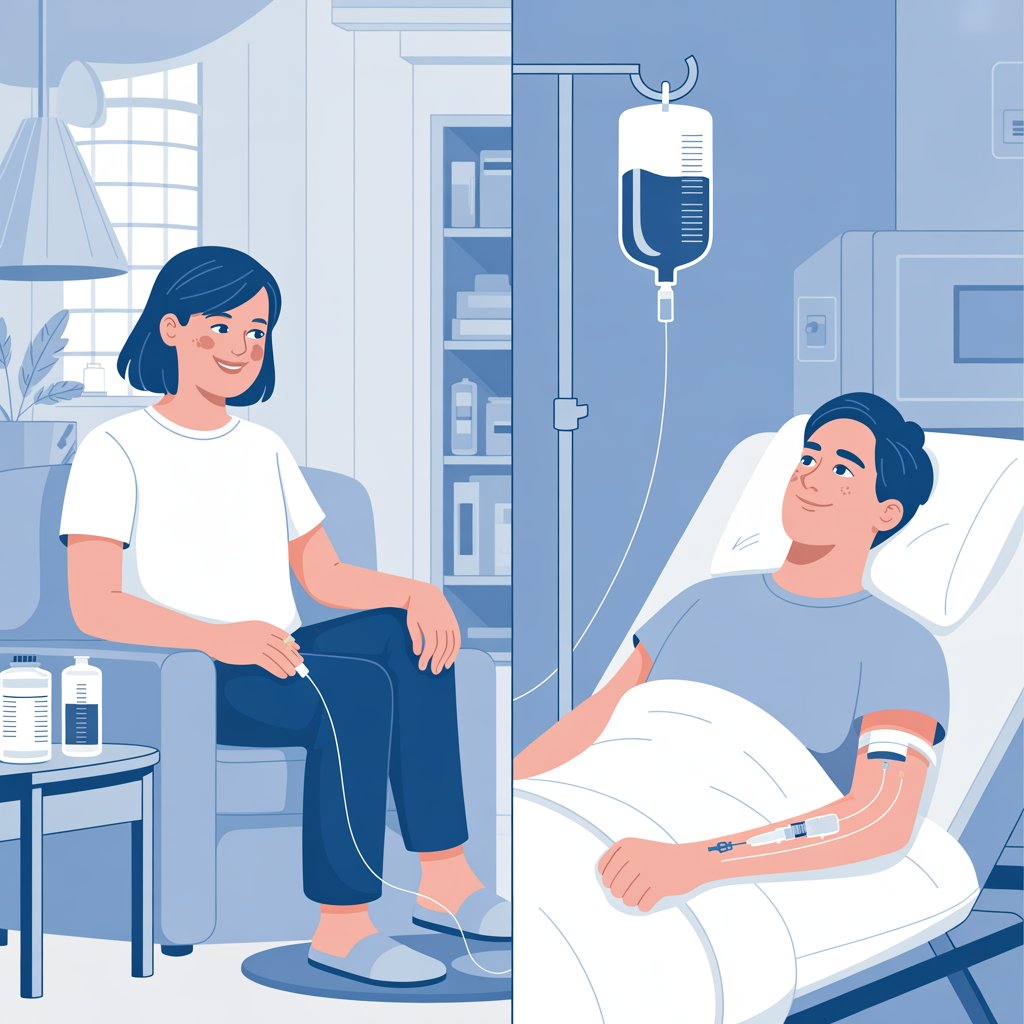
If you’ve been on IVIG for a while, you’ve probably had this thought: there has to be a better way than blocking out a full day every three or four weeks for an infusion. Maybe your veins are getting tired. Maybe you’re tired of the post-infusion headaches. Maybe you saw a fellow patient online talking about doing their immune globulin at home, weekly, with a small pump, and you want to know if that could be you.
That alternative is called SCIG — subcutaneous immunoglobulin. It uses the same medicine class as IVIG (antibodies pooled from thousands of healthy donors) but delivers it through a small needle just under the skin instead of through a vein. For many patients, it changes everything about how immunoglobulin therapy fits into their life.
This guide walks through how SCIG and IVIG compare, who’s a candidate for which, what the actual experience is like, what the major brands are, and how to think about the switch. We’ll also be honest about where SCIG is harder and where IVIG still wins. There is no universally right answer, only the answer that fits you.
| Curious whether SCIG could work for you? Our pharmacists handle the prescription change, training, pump setup, and insurance coordination. Most switches happen in under three weeks. ▶ Talk to a Pharmacist · (949) 555-0100 |
First, the Quick Difference
Both therapies deliver immunoglobulin G (IgG) — a class of antibodies your immune system uses to fight infection. Both are made by pooling and purifying plasma from thousands of screened, healthy donors. Both are used to treat primary immunodeficiency (PID), some secondary immunodeficiencies, and a growing list of autoimmune neurological conditions like CIDP and multifocal motor neuropathy.
The difference is the route and the rhythm.
| Feature | IVIG (intravenous) | SCIG (subcutaneous) |
|---|---|---|
| Route | IV line into a vein | Small needle under the skin |
| Frequency | Every 3 – 4 weeks | Weekly or every 2 weeks (or biweekly Hyqvia) |
| Duration per session | 3 – 6 hours | 1 – 2 hours typical |
| Setting | Infusion center or home with nurse | Home, self-administered after training |
| Premedication | Often needed (antihistamine, Tylenol) | Rarely needed |
| IgG levels | Peaks then drops between infusions | Steady, near-flat trough levels |
| Common side effects | Headache, fatigue, fever, body aches | Site swelling, redness, mild itching |
| Vein access required | Yes | No |
That last row is the headline for many patients. SCIG produces near-steady-state IgG levels, while IVIG creates a peaks-and-valleys pattern. For some patients, those valleys correspond to feeling worse a week before the next infusion. SCIG smooths that out.
Who’s a Good Candidate for Each?
SCIG is often a good fit for:
- Patients with poor vein access or a history of difficult IVs
- Patients who experience strong systemic side effects from IVIG (headaches, fatigue, body aches)
- Patients who want to avoid scheduling around infusion days at a center
- Active travelers and parents who need flexibility
- Pediatric patients (Hizentra and Hyqvia are approved for children)
- Patients who feel a clear loss of energy in the week before their next IVIG
- Patients comfortable with self-administration after training
IVIG is often a better fit for:
- Patients newly diagnosed who need rapid IgG loading doses
- Patients with very high dose requirements that would mean impractical SCIG volumes
- Patients who prefer one infusion every few weeks over weekly self-care
- Patients who cannot self-administer due to vision, dexterity, or comfort reasons (note: a caregiver or home health nurse can administer SCIG instead)
- Some autoimmune neurological patients during acute treatment phases
- Patients with insurance plans that strongly prefer IVIG on formulary
| 💡 Important: this isn’t an either-or for life Many patients start on IVIG, switch to SCIG once stable, and switch back if life circumstances change. We’ve worked with patients who do IVIG during the school year and SCIG during summer travel, and patients who used SCIG for years then switched to IVIG when they wanted to drop the weekly self-care routine. Your therapy can change as your life changes. |
What’s a SCIG Infusion Actually Like?
If you’ve never seen one, here’s the honest picture. A typical SCIG session involves:
- Setting up the pump and supplies. Most people do it at the kitchen table or a comfortable chair. You assemble the pump, draw up the medication into a syringe, and connect it to a small infusion set with two to four needle sites.
- Inserting the needles. The needles are short and fine — they sit just under the skin, not in a vein. Most people use the abdomen or thighs. The needles stay in for the duration of the infusion.
- Running the pump. The pump pushes the medication slowly under the skin over the course of 60 to 120 minutes. You can read, work, watch TV, eat, or move around the house with the pump on.
- Removing the needles and bandaging. Once the pump finishes, you remove the needles, apply small bandages, and you’re done.
The most common feedback we hear from patients who switched: “The site looks weird for the first hour, then it’s fine.” Most people develop small, fluid-filled bumps under the skin where the medication was infused. These reabsorb within 12 to 24 hours and are completely normal. Itching, redness, and mild swelling at the site are also common and tend to fade within a few infusions as your body acclimates.
What patients almost never report: the systemic side effects of IVIG. The big ones — headache, brain fog, body aches — happen far less often with SCIG because the medication absorbs slowly and your body never sees the peak concentration that triggers those symptoms.
The SCIG Products Available in 2026
There are several FDA-approved SCIG products on the U.S. market. Your insurance, dose requirements, and lifestyle preferences will guide which one is right for you.
| Brand | Concentration | Typical Frequency | Key Note |
|---|---|---|---|
| Hizentra | 20% | Weekly | Most prescribed SCIG; small volumes |
| Cuvitru | 20% | Weekly or biweekly | Higher infusion rates allowed |
| Xembify | 20% | Weekly | Fewer infusion sites needed for some patients |
| Hyqvia | 10% + hyaluronidase | Every 3 – 4 weeks | Subcutaneous but monthly schedule |
| Gammaked SC | 10% | Weekly | Older option, less common today |
A note on Hyqvia: it’s technically a SCIG product but uses an enzyme called hyaluronidase to temporarily open up the tissue and allow a much larger volume to be infused at once. The result is a subcutaneous route with an IVIG-like schedule (every 3 to 4 weeks). For patients who want to avoid IV access but don’t want weekly self-care, Hyqvia is often the answer.
| Wondering which SCIG product fits your life? We’ll review your dose, lifestyle, insurance coverage, and side effect history to recommend the right brand and schedule. ▶ Schedule a Consult · (949) 555-0100 |
How the Switch From IVIG to SCIG Actually Works
If you decide to switch, here’s the realistic timeline. The full transition usually takes three to six weeks from the conversation with your doctor to your first home SCIG infusion.
Week 1 — The clinical decision
Talk with your prescribing immunologist, neurologist, or hematologist. They confirm SCIG is appropriate for your condition and write the new prescription. Your dose will typically be calculated as the same total monthly amount, divided into weekly portions.
Weeks 1 – 2 — Insurance and pharmacy coordination
Your specialty pharmacy (that’s us) runs the prior authorization, confirms your benefits, and identifies any cost differences between the IVIG and SCIG options on your plan. SCIG is typically billed under medical benefits or pharmacy benefits depending on the product and plan, which can affect your out-of-pocket cost. We’ll quote that to you before anything ships.
Weeks 2 – 3 — Training
A specialty pharmacy nurse or trainer (in person or via telehealth, depending on your insurance) walks you through pump operation, needle placement, site rotation, supply storage, and what to do if something goes wrong. Most patients are independent after one to two training sessions.
Week 3 – 4 — First infusion at home
Your first home SCIG infusion is typically supervised by a nurse, either in person or via video. After one or two supervised sessions, you’re cleared to infuse on your own.
Months 1 – 3 — Adjustment period
Your specialty pharmacist follows up regularly during the first three months. If you’re getting site reactions, having pump trouble, or questioning whether the switch was worth it, this is the window where we troubleshoot. After three months, most patients are running on autopilot.
Honest Comparison of Side Effects
IVIG side effects you might not miss
- Headaches and migraines. Common in the 24 hours after infusion, sometimes severe. Aseptic meningitis is a rare but serious version.
- Fatigue and brain fog. Many patients describe feeling “hit by a truck” the day after IVIG.
- Fever and chills. Especially with newer brands or when changing brands.
- Hypertension and fluid overload risk. Particularly relevant for older patients and patients with kidney or heart issues.
- Difficult IV access. After years of IVIG, vein scarring is real for some patients.
SCIG side effects you’ll need to expect
- Site reactions. Redness, swelling, fluid bumps, occasional bruising. Most fade within hours. Severity decreases over the first weeks.
- Mild local itching. Common and usually transient.
- The weekly time commitment. Not a side effect per se, but a real lifestyle factor. One to two hours, every week, every week, every week.
- Pump failures and supply issues. Rare but they happen. We replace pumps the next business day.
| ⚠️ When to call us right away Severe site reaction with spreading redness or pain, fever after a SCIG infusion, signs of infection at a needle site, sudden loss of effectiveness (more infections than usual), or any allergic-type symptoms (hives, difficulty breathing, swelling). These are uncommon but real. Our pharmacist line is staffed 24/7. |
Cost: SCIG vs IVIG
There is no universal answer here. SCIG and IVIG can both be expensive, and your out-of-pocket cost depends entirely on your insurance plan, the brand prescribed, and whether the medication is billed under your medical benefit or your pharmacy benefit. A few patterns we see consistently:
- Medicare patients often have meaningfully different out-of-pocket costs between IVIG (typically Part B) and certain SCIG products (which may fall under Part B or Part D depending on context). Check both before assuming one is cheaper.
- Commercial insurance patients often find SCIG and IVIG cost roughly the same out-of-pocket if both are on formulary. The deciding factor becomes lifestyle, not money.
- Manufacturer co-pay assistance programs exist for most brand SCIG products and can dramatically reduce cost for commercially insured patients.
- Patient assistance foundations (IDF SCID Compass, Patient Services Inc., HealthWell Foundation) provide grants for immunoglobulin therapy regardless of route.
| 💡 Always run the numbers before switching We do a full benefits investigation before any switch. You’ll know your monthly cost on SCIG before we ship the first dose. If the math doesn’t work, we identify assistance programs or recommend staying on IVIG. You will not be surprised by a bill. |
How We Help: River’s Edge and Immunoglobulin Therapy
Immunoglobulin therapy is one of the most established service lines we offer, and it’s where specialty pharmacy makes the biggest difference for patients. For SCIG specifically, we coordinate:
- Prescription verification and benefits investigation, with a written cost quote before anything ships
- Pump and supply delivery (everything you need, on a schedule that matches your dosing)
- In-home or telehealth training with a registered nurse or trainer
- Clinical pharmacist availability 24/7 for questions, side effects, or pump issues
- Coordination with your prescribing physician on dose adjustments, lab monitoring, and trough levels
- Co-pay assistance and foundation grant applications when needed
We treat SCIG patients as long-term partners. Most of our SCIG patients are with us for years, and we know their dosing schedules, their preferred infusion times, and the brand-name vacations they’re traveling for in two months. That continuity matters for a therapy you’ll likely be on for life.
| Ready to talk about SCIG, IVIG, or switching? Same pharmacists, same answer line, same coordination team — whether you stay on IVIG or move to home SCIG. ▶ Contact River’s Edge · (949) 555-0100 |
Frequently Asked Questions
Q: Will SCIG work as well as IVIG for my condition?
For PID and most secondary immunodeficiencies, yes. Studies show equivalent infection prevention when total monthly IgG dose is matched. For some autoimmune neurological conditions like CIDP, SCIG (specifically Hizentra at higher doses) is FDA-approved and clinically validated. Your prescriber will confirm whether SCIG is appropriate for your specific condition.
Q: How much weekly time does SCIG actually take?
Most patients spend 1 to 2 hours per week on SCIG, including setup, the infusion itself, and cleanup. With Hyqvia, it’s longer (2 to 4 hours) but only every 3 to 4 weeks instead of weekly.
Q: Can I travel on SCIG?
Yes, and many patients tell us SCIG made traveling possible again. You’ll need to plan for refrigerated storage (most products are stored in the fridge) and bring supplies in your carry-on. We can ship supplies to a destination address with advance notice. TSA accepts SCIG supplies as medical equipment.
Q: What if I’m scared of self-administering?
Most patients are nervous before their first infusion and confident by their fourth. Our trainers do not rush you. If self-administration genuinely isn’t right for you, a caregiver can be trained instead, or a home health nurse can come weekly. SCIG is still possible without self-administration.
Q: What if I switch to SCIG and don’t like it?
You can switch back. Your prescriber writes a new IVIG order, we run the prior auth, and you transition back. Patients who switch back most commonly cite the weekly time commitment, not clinical concerns. We never lock you in.
Q: Are there any patients who shouldn’t try SCIG?
A few. Patients on extremely high doses may need impractical SCIG volumes per session. Patients with certain skin conditions or severe needle phobia may struggle. Patients in acute autoimmune flare may need IVIG for faster onset. Your prescriber and pharmacist will flag any reasons SCIG isn’t a good fit.
Q: Is SCIG covered by Medicare?
It depends on the product and the indication. Some SCIG products and indications are covered under Medicare Part B; others fall under Part D. The coverage rules are genuinely confusing. Our benefits team runs your specific plan and gives you the answer in plain English before anything ships.
| 💡 Schema markup note for developers FAQPage schema for the 7 Q&As above. Drug schema entries for Hizentra, Cuvitru, Xembify, Hyqvia, Gammaked. MedicalCondition schema for primary immunodeficiency, CIDP, multifocal motor neuropathy. Author should be Person schema with credential PharmD and medicalSpecialty: Pharmacy. |
The Takeaway
SCIG and IVIG aren’t competing therapies. They’re two ways to deliver the same family of medication, each with its own rhythm and tradeoffs. IVIG is fewer, longer sessions with the comfort of a clinical setting and the cost of peaks-and-valleys IgG levels. SCIG is more frequent, shorter, self-managed sessions with the freedom of doing it on your terms and the cost of the weekly commitment.
If you’re stable on IVIG and content with your routine, there’s no reason to switch. If something about IVIG isn’t working for you anymore — the side effects, the schedule, the vein access, the recovery time — SCIG is worth a real conversation with your doctor and your specialty pharmacist. Many patients tell us, six months in, that they wish they’d asked about SCIG sooner.