



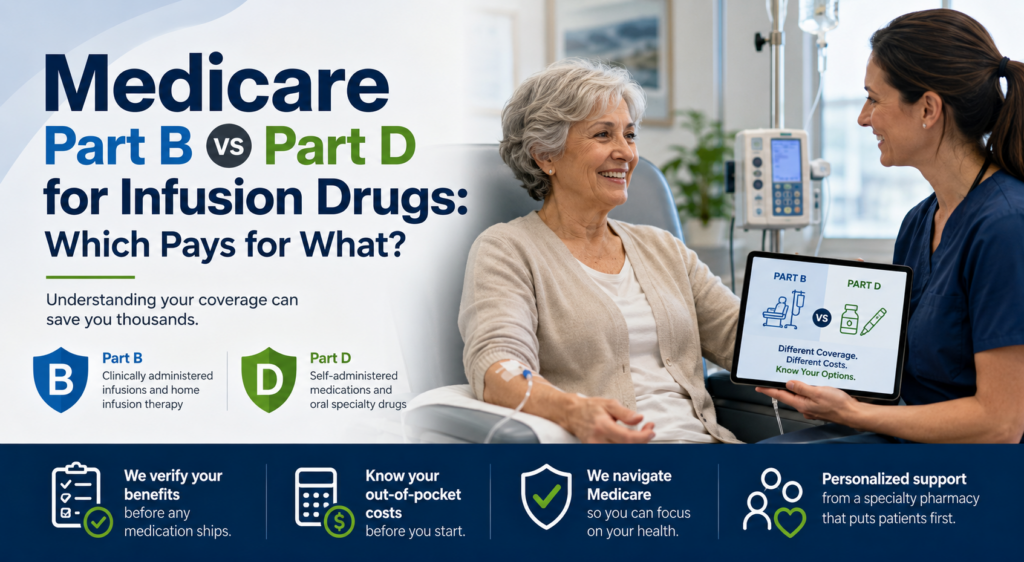
Your doctor wants to start you on an infusion medication. Maybe it’s IVIG. Maybe it’s Remicade, Ocrevus, or an iron infusion. Someone mentions “this should be covered under Part B.” Someone else says “that one’s Part D.” You nod like you understand. You don’t. Nobody actually does on the first try.
Medicare’s split between Part B and Part D coverage for infusion drugs is one of the most confusing parts of the entire program. The rules aren’t intuitive, the same drug can fall under different parts depending on where and how it’s given, and your out-of-pocket cost can vary by hundreds or thousands of dollars per year based on which part covers your medication.
This guide is the plain-English version. We’ll walk through which infusion drugs typically fall under Part B versus Part D, why the distinction matters for what you actually pay, how Medicare Advantage and Medigap fit in, and when the rules get weird (because they do). The goal is for you to walk into your doctor’s office or your specialty pharmacy with a working understanding of how your coverage actually works.
| Confused about which Medicare part covers your medication? We run benefits for every Medicare patient before any medication ships. You’ll know exactly what you’ll pay before we move forward. ▶ Call (949) 555-0100 · Get a Benefits Check |
The Big Picture: Part A, B, C, and D
Quick refresher, because the Medicare alphabet matters here:
- Part A — hospital insurance. Covers inpatient stays. Not relevant for most outpatient infusion therapy.
- Part B — medical insurance. Covers outpatient services, doctor visits, and certain medications administered in clinical settings or under the home infusion therapy benefit.
- Part C (Medicare Advantage) — a private insurance alternative to original Medicare. Combines Parts A, B, and usually D. Different rules, often different costs.
- Part D — prescription drug coverage. Covers most medications you’d pick up at a pharmacy or self-administer at home.
For infusion drugs, the big question is Part B vs Part D. The same medication can sometimes fall under either, depending on factors most patients have no reason to know about. That’s where this gets thorny.
The General Rule (That Has Lots of Exceptions)
Medicare’s basic logic for infusion drugs goes like this:
| Medication is covered by… | When this is true |
|---|---|
| Part B | It’s administered by a healthcare professional (doctor’s office, hospital outpatient, infusion center) |
| Part B | It’s not generally self-administered (most biologics and IV chemotherapy) |
| Part B | It’s furnished under the Home Infusion Therapy Services Benefit |
| Part B | It requires Durable Medical Equipment (DME) like an infusion pump |
| Part D | It’s a self-administered medication you pick up at a pharmacy |
| Part D | It’s an oral specialty drug (most pills, even high-cost ones) |
| Part D | It’s a self-injectable that doesn’t fall under Part B’s specific carve-outs |
If you’re thinking “that seems straightforward,” wait. The exceptions are where most patients get tripped up. The same medication can be Part B in one setting (administered at an infusion center) and Part D in another (self-administered at home as an injection). The home infusion benefit has its own carve-outs. And Part B has specific lists of self-administered drugs that get coverage anyway because of how the law was written.
| 💡 The most common confusion A drug given by IV infusion at a doctor’s office or infusion center is almost always Part B. The same drug as a self-injectable version (different formulation) might be Part D. Examples: IVIG given IV at a center is Part B. Hizentra (subcutaneous immunoglobulin) self-administered at home is sometimes Part B (under the home infusion benefit) and sometimes Part D (depending on coverage rules). Always confirm with your specialty pharmacy. |
Common Infusion Drugs and Their Typical Medicare Coverage
Here’s a quick reference for medications River’s Edge dispenses regularly. Note: these are typical patterns, not guarantees — the specifics always depend on your plan, your prescriber’s documentation, and where the drug is administered.
| Medication | Used For | Typical Medicare Part |
|---|---|---|
| Remicade / Inflectra / Renflexis | Crohn’s, RA, UC | Part B (administered at infusion center) |
| Ocrevus | MS | Part B |
| Tysabri | MS | Part B |
| IVIG (Privigen, Gammagard, etc.) | PID, CIDP, MMN, autoimmune | Part B (most common); some plans Part D |
| Hizentra / Cuvitru / Xembify (SCIG) | PID, CIDP | Often Part B under home infusion benefit |
| Hyqvia | PID | Part B for most beneficiaries |
| Injectafer / Feraheme (iron) | Iron deficiency anemia | Part B |
| Hemophilia factor (Advate, Eloctate, etc.) | Hemophilia A/B | Part B |
| Hemlibra | Hemophilia A | Part D (self-injected) |
| TPN (parenteral nutrition) | Intestinal failure | Part B under home infusion / DME benefits |
| Most oral specialty drugs | Various | Part D |
| Most chemotherapy infusions | Cancer | Part B |
This table is a starting point, not a final answer. The same drug for the same patient can sometimes be classified differently based on plan-specific coverage decisions. We always run a benefits investigation before any medication ships, so you have a precise answer for your plan and your situation.
Why the Difference Matters: What You Actually Pay
Part B costs
Under traditional Medicare Part B, you typically pay 20% of the Medicare-approved amount after meeting your annual Part B deductible. There’s no out-of-pocket maximum with traditional Part B alone — which is a big deal for high-cost specialty drugs.
Example: a year of Ocrevus at the Medicare-allowed rate (around $90,000 list price) could leave a Part B-only patient owing $18,000 in coinsurance. This is why most Medicare patients with specialty drug needs carry Medigap (Medicare Supplement) insurance, which covers most or all of the 20% Part B coinsurance.
Part D costs
Part D works in tiers (formulary placement) with specific cost-sharing structures. As of 2025, Part D includes a new $2,000 annual out-of-pocket cap — a major improvement for patients on high-cost specialty drugs. After you reach $2,000 in out-of-pocket spending, your Part D plan covers 100% for the rest of the year.
This $2,000 cap is one of the biggest changes to Medicare coverage in years and is especially impactful for patients on expensive Part D specialty drugs.
Medicare Advantage costs
Medicare Advantage (Part C) plans bundle Part A, B, and usually D into a single private plan with its own cost-sharing structure. Most have an annual out-of-pocket maximum (typically $4,000 to $8,500 for in-network care), which provides a hard cap that traditional Part B alone doesn’t have. The tradeoff is narrower networks and plan-specific formularies.
| ⚠️ If you’re on traditional Medicare without Medigap or Part D And you’re starting a high-cost infusion therapy, this is a critical conversation to have right now. Without supplemental coverage, you could owe 20% of every infusion’s cost with no annual cap. Medigap policies can be purchased during specific enrollment windows; missing those windows can make later enrollment difficult and more expensive. Talk to your specialty pharmacy or a Medicare counselor (SHIP, your state’s free Medicare advisory service) before you start treatment. |
| Need help comparing your options before treatment starts? We don’t sell insurance, but we’ll explain exactly how your current Medicare coverage applies to the medication your doctor prescribed. ▶ Schedule a Benefits Review · (949) 555-0100 |
The Medicare Home Infusion Therapy Benefit
Home infusion deserves its own section because the rules here are particularly tangled. Medicare Part B covers home infusion in two main ways:
1. The Home Infusion Therapy Services Benefit
Established in 2021, this benefit covers professional services (nursing visits, training, monitoring) for home infusion patients. The benefit covers Medicare-approved drugs that fall on a specific list, administered through a Medicare-qualified home infusion supplier. The drug itself is covered separately — sometimes under Part B, sometimes Part D, depending on the medication.
2. The DME (Durable Medical Equipment) benefit
Some infusion therapies are covered through Medicare’s DME benefit when an external infusion pump is medically necessary. This applies to certain IV antibiotics, chemotherapy, IV pain management, and some other therapies that require pump administration.
Practically, this means: if your therapy involves a pump and a Medicare-qualified home infusion provider, your coverage is usually a mix of Part B for the drug and equipment, plus the Home Infusion Therapy Services Benefit for the nursing services. There’s no single “home infusion bucket” — it’s pieced together from multiple benefits.
Medicare Advantage: Same Rules, Different Wrapper
If you’re on a Medicare Advantage (MA) plan, the same Part B vs Part D logic generally applies — but your specific plan’s formulary, prior authorization rules, and cost-sharing decisions affect what you actually pay. MA plans are required to cover everything traditional Medicare covers, but they have flexibility in how they cover it.
Common MA-specific quirks:
- MA plans often have stricter prior authorization requirements than traditional Medicare for specialty drugs
- Network restrictions can affect which infusion centers and home infusion providers you can use
- Formulary tier placement determines your Part D portion of cost-sharing on MA plans that bundle drug coverage
- MA plans must cap your annual out-of-pocket spending (CMS sets the maximum), which can be a meaningful protection vs. traditional Medicare alone
- Some MA plans negotiate aggressive specialty drug formularies — confirm coverage before assuming
Practical Steps for Medicare Patients Starting Infusion Therapy
- Find out which part covers your specific drug. Don’t guess. Ask your specialty pharmacy. The answer affects your entire cost picture.
- Confirm your supplemental coverage. Medigap, Part D, Medicare Advantage — each one changes your math. If you only have traditional Medicare without supplemental coverage, this is the first conversation to have.
- Get a written cost estimate. Specialty pharmacies (good ones) provide a written breakdown of your expected out-of-pocket cost before any medication ships. This includes deductibles, coinsurance, and projected annual exposure.
- Understand the prior authorization timeline. Medicare Advantage standard PA can take up to 14 days. Plan accordingly so you don’t run out of medication during the wait.
- Look into manufacturer assistance and foundations. Manufacturer co-pay programs are typically not available to Medicare patients due to anti-kickback rules. But foundation grants (HealthWell, PAN, Patient Services Inc., disease-specific foundations) can dramatically reduce out-of-pocket costs for Medicare patients.
- Re-evaluate annually. Medicare’s Annual Election Period runs October 15 to December 7 each year. Your plan’s formulary, network, and cost structure can change. Specialty pharmacy patients should review coverage every year.
| ✓ The biggest cost-saving move for Medicare patients on specialty drugs If you’re on traditional Medicare with a Part B-covered infusion drug, getting Medigap coverage (or switching to a Medicare Advantage plan with an out-of-pocket maximum) is often the single most important financial decision you’ll make. The 20% Part B coinsurance with no cap can be devastating for high-cost therapies. Don’t wait until you’re already on treatment to figure this out. |
How a Specialty Pharmacy Helps Medicare Patients
Medicare is genuinely confusing, and our team’s job includes translating it into actual numbers and actual next steps for every patient. What we do for Medicare beneficiaries:
- Run a complete benefits investigation across Part B, Part D, and any supplemental coverage you carry
- Identify whether your specific drug falls under Part B or Part D under your specific plan
- Calculate your projected annual out-of-pocket cost with all coverage layered together
- Search foundation grant databases for assistance programs you qualify for as a Medicare beneficiary
- Coordinate with home infusion partners that meet Medicare’s qualified-supplier requirements
- Handle Medicare Advantage prior authorization, including peer-to-peer reviews and appeals when needed
- Re-verify your benefits each year during Annual Election Period and flag changes that affect you
- Provide written cost quotes before any medication ships — no surprise bills
Medicare patients deserve more time and explanation than the average insurance company representative gives them. Our team takes that time. If you’re approaching Medicare or just transitioned in and you’re staring at a specialty drug prescription, call us. We’ll walk you through it.
| Want a real explanation of your Medicare coverage? We translate Medicare into plain English and actual dollars. Bring us your prescription and your insurance information, and we’ll do the rest. ▶ Contact River’s Edge · (949) 555-0100 |
Frequently Asked Questions
Q: Is IVIG covered by Part B or Part D?
IVIG given as IV infusion at an infusion center is almost always Part B. SCIG (subcutaneous immunoglobulin) self-administered at home can be Part B (under the home infusion benefit) or Part D depending on the brand and your specific plan. We confirm coverage for every patient before shipment.
Q: Does Medicare cover home infusion?
Yes, in two main ways: the Home Infusion Therapy Services Benefit (which covers professional services for qualifying drugs and providers) and the DME benefit (which covers infusion pumps for certain therapies). The drug itself is covered separately, usually under Part B. Coverage of professional services requires a Medicare-qualified home infusion supplier.
Q: Why does my Part B-covered drug cost so much?
Traditional Medicare Part B has no annual out-of-pocket maximum. You owe 20% of the Medicare-approved amount on every infusion, with no cap. Without Medigap (Medicare Supplement) coverage to fill that gap, costs can climb quickly on high-priced specialty drugs. Medigap or a Medicare Advantage plan with an out-of-pocket maximum can dramatically reduce your exposure.
Q: Can I get manufacturer co-pay assistance as a Medicare patient?
Generally no. Federal anti-kickback rules prevent manufacturers from offering co-pay assistance directly to Medicare and Medicaid patients. The good news: independent foundation grants (HealthWell, PAN, Patient Services Inc., and disease-specific foundations) are available to Medicare patients and can substantially offset costs. Your specialty pharmacy will help identify and apply to qualifying programs.
Q: How does the new $2,000 Part D cap affect me?
Starting in 2025, Part D beneficiaries pay no more than $2,000 out-of-pocket per calendar year for covered drugs. Once you hit $2,000 in out-of-pocket spending, the rest of your Part D drug costs are covered for that year. This is an enormous improvement for patients on high-cost Part D specialty drugs. Note that this cap applies only to Part D drugs, not Part B.
Q: Should I switch from traditional Medicare to Medicare Advantage?
It depends on your situation. Medicare Advantage offers an out-of-pocket maximum that traditional Medicare alone doesn’t, which is meaningful for specialty drug patients. But MA plans have networks, formulary restrictions, and stricter prior authorization. The right choice depends on your drugs, your providers, and your tolerance for managing utilization rules. A Medicare counselor (SHIP — the State Health Insurance Assistance Program is free in every state) can help you compare options without bias.
Q: What happens if my drug switches between Part B and Part D coverage?
It can happen, especially when a manufacturer adds a self-injectable formulation of an existing IV drug. Your specialty pharmacy will identify the change, confirm the new coverage path, and help you understand any cost differences. The medication is still available; the billing pathway just shifts.
| 💡 Schema markup note for developers FAQPage schema for the 7 Q&As. Article schema with author Person (credential PharmD). HowTo schema for the practical-steps section. BreadcrumbList for navigation hierarchy. Add structured data referencing 2025 Part D out-of-pocket cap as a publishedDate-stamped fact. |
The Takeaway
Medicare’s split between Part B and Part D for infusion drugs isn’t intuitive, and it shouldn’t be on you to figure out. The same medication can fall under different parts depending on setting, route, and plan. The financial difference between coverage paths can be thousands of dollars per year. And the rules continue to evolve, with the new $2,000 Part D cap being the biggest improvement for patients in years.
What you don’t have to navigate alone is your own coverage. A specialty pharmacy that works with Medicare patients every day will run your benefits, identify foundation grants, coordinate with home infusion suppliers, and translate the bureaucracy into a clear answer about what you’ll pay. The medication is the easier part. The coverage maze is what we exist to walk through with you.